Why Your Next SaaS Project Needs a Production-Ready Foundation
Every indie maker knows the "empty repo" paralysis. You have a vision for a world-changing SaaS, but before you can write a single line of business logic, you spend weeks wiring up authentication, wrestling with Stripe webhooks, and debating folder structures. By the time you’re ready to build, the initial momentum has faded, and the "yak shaving" has taken over.
What if you could skip the setup and start at the finish line?
That is the core philosophy behind SaaS Blueprint. It isn't just another template or a collection of snippets; it is a battle-tested, production-grade foundation that is already powering live applications. If you are tired of reinventing the wheel for every project, this might be the most important tool in your developer stack.
The Problem with "Starter Kits"
The market is flooded with starter kits, but most of them suffer from the same flaw: they are built as demos. They work fine for a "Hello World" project, but as soon as you try to scale them or add complex features, the architecture falls apart. You end up spending more time refactoring the "starter" than you would have spent building from scratch.
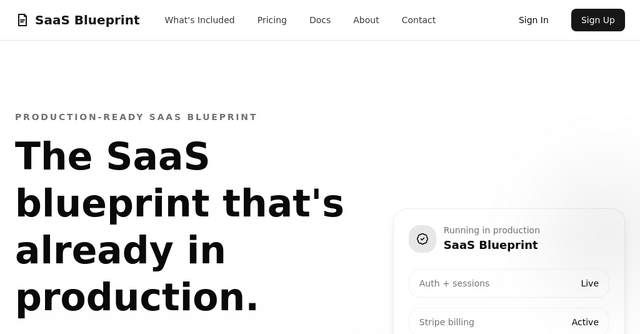
SaaS Blueprint takes a different approach. Instead of a demo, you are cloning the exact codebase that powers its own marketing site and dashboard. It is designed for developers who want to ship, not just tinker. It provides the intentional architecture, established patterns, and production-ready conventions that keep a project maintainable as it grows from a side project to a revenue-generating business.
Why This is the Ultimate AI-Ready Architecture
If you are currently leveraging AI tools like Claude, ChatGPT, or Cursor to accelerate your development, you have likely encountered the "hallucination trap." When you feed an AI a messy, unstructured codebase, it guesses. It makes up non-existent patterns, breaks your routing, and creates fragile integrations.
This is where the blueprint truly shines. By providing a clear, opinionated structure, it acts as a roadmap for your AI coding assistant. Because the code is built on established conventions for data access, routing, and authentication, the AI understands the "rules" of your app. It makes fewer mistakes, suggests more accurate code, and helps you iterate faster without the need for constant hand-holding. You aren't just prompting against a blank canvas anymore; you are prompting against a system that knows exactly how it’s supposed to function.
What’s Under the Hood?
When you clone the repository, you aren't getting a handful of components—you are getting a complete, integrated system. Here is why the included features matter for your bottom line:
1. Robust Authentication & Security
Authentication is the one area where you cannot afford to cut corners. The blueprint comes with email/password support and GitHub OAuth fully implemented. More importantly, it handles sessions, protected routes, and user profile management out of the box. You get secure access control that ensures your paid features stay gated and your user flows remain predictable.
2. End-to-End Stripe Integration
Monetization is often the most painful part of the SaaS development journey. The blueprint handles the heavy lifting:
- Checkout Flows: Ready-to-use pricing and subscription UI.
- Webhook Syncing: Reliable billing state management that keeps your database in sync with Stripe.
- Customer Management: Pre-built billing screens that allow users to manage their subscriptions, promo codes, and upgrade/downgrade paths.
3. Documentation as a First-Class Citizen
Most developers treat documentation as an afterthought. SaaS Blueprint treats it as code. With built-in Velite support, your documentation lives in your repository as Markdown or MDX files. This creates a single source of truth that is versioned alongside your app, ensuring that your logic and your docs never fall out of sync.
4. Minimal, Unopinionated UI
We’ve all seen "template-heavy" kits that force you into a specific design language that is impossible to override. The blueprint uses a minimal, clean UI based on shadcn components. It provides the structure you need without locking you into a specific aesthetic. It’s a blank slate that’s ready for your branding, your design system, or your favorite component library.
Built for Cloudflare Performance
While you have the flexibility to deploy on Vercel, the architecture is intentionally optimized for Cloudflare. This choice isn't accidental—it’s driven by the need for edge-first performance and predictable, affordable pricing. If you are building a modern SaaS, you want an infrastructure that scales without breaking your budget, and this blueprint is designed to live comfortably on the edge.
Who is SaaS Blueprint For?
This tool is built for indie makers, solopreneurs, and small startup teams who value their time. If you find yourself spending more time setting up "boilerplate" than building features that solve real user problems, this is for you.
- The Solo Founder: You need to move fast to validate your idea. You don't have time to debug Stripe webhooks or session handling.
- The AI-Powered Developer: You use AI to generate features and want a codebase that won't confuse your coding assistant.
- The "Ship-First" Team: You want to get to production, gather feedback, and iterate. You need a codebase that is as reliable in production as it is on your local machine.
How to Get Started
The path to production is simple, and it’s the same path the creator follows:
- Buy Access: Get instant access to the repository.
- Clone the Repo: Pull the exact stack used to build the marketing site and dashboard.
- Deploy: Ship your product with the same infrastructure that powers the blueprint itself.
Stop wasting your energy on the "yak shaving" of SaaS development. By choosing a foundation that is already in production, you can focus on what actually matters: building a product that your users love.
Ready to stop reinventing the wheel? Check out SaaS Blueprint today and start building faster.