Stop Designing and Start Shipping: How Cuttly Helps Indie Makers Validate Ideas Faster
Every indie maker has been there: you have a brilliant SaaS idea, a solid backend architecture, and a burning desire to ship. But then, you hit the "landing page wall." You spend your entire weekend tweaking CSS, fighting with responsive breakpoints, and agonizing over whether your button color is "conversion-optimized" enough. By the time you’re ready to launch your MVP, the initial excitement has faded, and you’re already behind schedule.
We often mistake "polishing a landing page" for "validating an idea." The truth is, your prospects don't care if you spent 40 hours in Webflow. They care about whether your solution solves their problem.
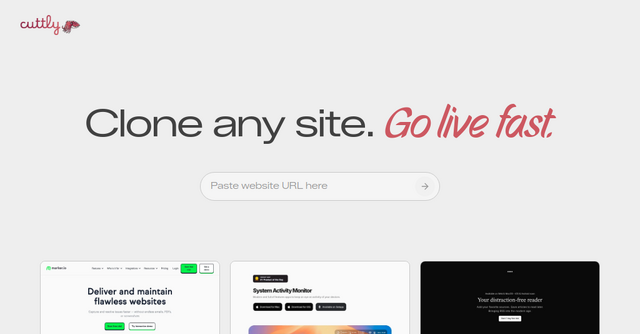
This is exactly why Cuttly caught our attention. It’s a SaaS tool designed to bypass the design grind entirely, allowing you to clone high-converting layouts, customize them, and get your offer in front of users in minutes, not days.
What is Cuttly?
At its core, Cuttly is a modern website cloner built for the way the web works today. Unlike legacy scrapers that were designed for the static HTML web of the late 90s, Cuttly is engineered to handle modern frontend frameworks like React, Vue, and Next.js.
It allows you to take any public landing page that you admire, clone its structure and design, and then own the complete source code. You aren't tied to a proprietary builder; you get the code, which means you can host it wherever you want and modify it to your heart's content.
Why Indie Makers Are Switching to Cloning
For solopreneurs and indie builders, time is the only currency that matters. Cuttly isn't about replacing your creative vision; it’s about removing the technical friction that stops you from testing your market.
1. Kill Weak Ideas Early
The biggest trap for indie SaaS developers is building for months without talking to a single user. With Cuttly, you can find a site structure that you know converts, swap in your messaging, and launch an experiment in a single afternoon. If the idea doesn't get traction, you’ve lost a few hours of work instead of weeks of development time.
2. Personalized Outreach That Actually Works
Cold outreach is often ignored because it feels generic. Imagine sending a prospect a link that looks exactly like their current website, but with your product integrated as a feature or improvement. You aren't just sending a pitch deck; you are showing them a tangible version of their own business, already improved by your solution. That’s how you turn cold leads into warm conversations.
3. Polish Without the "UI Grind"
Hackathons and product launches reward polish. Judges and early adopters are visual creatures—if your demo looks like a rough wireframe, it’s harder to get buy-in. Cuttly lets you start from a production-ready layout so you can spend your time on the actual product logic, flow, and story. Your project looks like it had a dedicated design team, even if it’s just you and a keyboard.
4. Skip the Client Mockup Stalls
If you’re a freelancer or agency owner, you know the "design feedback loop" nightmare. Clients often struggle to visualize the final product based on moodboards. With this website copier, you can clone a reference site, apply the client's branding, and send them a working, live mockup. When the client can touch and feel the final result, their feedback becomes concrete, and the project moves forward significantly faster.
The Problem with "Old School" Website Cloners
If you’ve tried using tools like HTTrack or wget in the past, you’ve likely been frustrated by broken interactions. Those tools were built when the web was just static pages.
Modern SaaS products are applications, not just documents. They rely on complex JavaScript, client-side routing, API calls, and hydration. When you use an outdated cloner, you usually end up with a broken mess that fails the moment a user clicks a button.
Cuttly solves this by respecting the architecture of modern web frameworks. It’s built for the current ecosystem, ensuring that the clones you create actually behave like modern websites. It bridges the gap where AI-based cloners often fail—retaining the animations, assets, and interactions that make a site feel "real."
How to Get Started with Cuttly
The workflow is intentionally simple, designed to get you from "idea" to "live" as fast as possible:
- Find Your Inspiration: Browse the web for a landing page that captures the vibe and conversion flow you want for your product.
- Clone Instantly: Enter the URL into Cuttly. The tool handles the heavy lifting, pulling the layout and structure for you.
- Customize: Since you own the code, you can easily swap out the text, images, and videos to align with your brand and USP.
- Deploy: Because you have the source code, you can deploy your site to Vercel, Netlify, or any other hosting provider of your choice. No lock-in, no hidden fees.
Frequently Asked Questions
Is Cuttly free to use?
Pricing for Cuttly starts as low as $1, making it an incredibly accessible tool for indie makers who need to validate ideas without breaking the bank.
Can I export to Figma?
Cuttly is focused on producing deployable, functional code rather than static design files. By providing the actual source code, it skips the "design-to-code" step entirely, allowing you to go straight to a live site.
Does it handle complex animations and videos?
Yes, one of the primary advantages of Cuttly over legacy tools is its ability to handle modern assets. It is designed to capture the elements that make modern sites look professional, including animations and media, ensuring your clone doesn't feel like a hollow shell.
Final Thoughts: Stop Guessing, Start Shipping
The most successful indie makers aren't the ones who build the most perfect landing pages; they are the ones who ship the most experiments.
Every hour you spend wrestling with a grid system is an hour you aren't talking to customers or refining your core value proposition. Cuttly gives you a shortcut to professional-grade presentation, letting you skip the "how do I make this look good?" phase so you can get straight to the "is this product valuable?" phase.
If you’re ready to stop over-engineering your landing pages and start validating your SaaS ideas, head over to Cuttly and see how much time you can save on your next launch.