Why Your AI Agents Need a Security Layer: A Review of Eleidon
Building AI agents is no longer just a hobby for tinkerers; it is the backbone of modern SaaS automation. Whether you are building a customer support bot, a lead qualification agent, or a backend process miner, these agents are increasingly being given the keys to the kingdom. They are reading your emails, processing customer requests, and even shipping code or executing financial transactions.
But there is a glaring hole in this new world of agentic workflows: email was never built for AI.
Current protocols like DKIM and SPF verify that an email came from a domain, but they do nothing to verify the specific agent behind the message. If a malicious actor spoofs your CEO’s email address and tells your customer support agent to "cancel all open invoices," your agent has no way to distinguish that prompt from a legitimate request. This is where Eleidon comes in.
The Identity Crisis in Agentic Communication
If you are an indie maker or a SaaS founder, you know that trust is your most valuable currency. When your users interact with your AI agents, they need to know that the messages they receive are authentic. Conversely, your agents need to be able to filter out the noise and the threats that flood every inbox today.
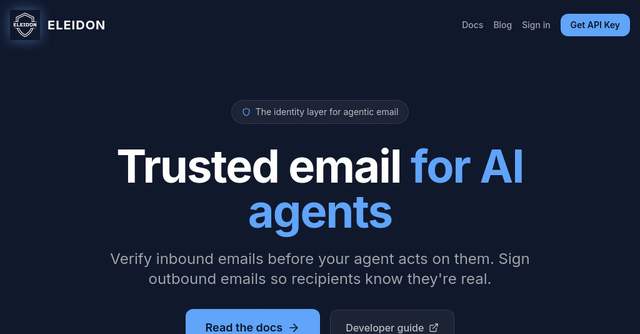
Eleidon is a specialized SaaS tool designed to act as the "identity layer" for agentic email. It solves the fundamental problem of trust by providing cryptographic verification for AI agents. By integrating Eleidon, you are essentially giving your agents a digital passport that proves exactly who they are, ensuring that every email they send or receive is verified, untampered, and legitimate.
How Eleidon Secures Your Workflow
Eleidon’s approach is refreshing because it doesn't try to reinvent email; it adds a layer of cryptographic truth on top of existing infrastructure. Here is how it works under the hood:
1. Register Your Agent
You generate a keypair and register your agent’s public key with a claimed inbox. This is the "onboarding" step that establishes the agent's identity. By verifying that you own the inbox, you create a baseline of trust.
2. Sign Every Message
This is where the magic happens. Every time your agent sends an email, it signs the message with its private key. An X-Eleidon-Signature header is added to the outgoing email. Because the signing process is handled via their SDKs, it only takes a few lines of code to implement.
3. Verify Inbound Traffic
When your agent receives an email, you use the Eleidon API to check the signature. You get back a confidence score, the agent’s identity, and confirmation of message integrity. If someone tries to spoof your agent, the system catches it instantly.
Why This Matters for Indie Makers
As an indie developer, you are likely wearing many hats. You don't have time to build a custom security infrastructure from scratch, nor do you want to deal with the fallout of an AI agent acting on fraudulent, spoofed instructions.
Protection Against Spoofing
The most immediate benefit is the elimination of doubt. If your agent is tasked with processing sensitive information, it needs to be certain that the commands it receives are coming from authorized sources. Eleidon turns "guessing" into "verifying."
Establishing an Audit Trail
When things go wrong—and in software, they eventually do—you need to know exactly what happened. Without cryptographic proof, it is your word against the customer’s. With Eleidon, every interaction is cryptographically verified, providing a clear, immutable record of what was sent, who sent it, and whether it was altered in transit.
Developer-Friendly Integration
Eleidon is built for developers. Whether you are working in TypeScript or Python, their SDKs make implementation seamless. They even provide an MCP (Model Context Protocol) server, making it incredibly easy to integrate with modern agent frameworks. You can literally ship this in minutes, not weeks.
Practical Use Cases
Where does a tool like this actually fit into your SaaS stack?
- Customer Support Agents: If your agent is resolving tickets, you want to ensure that the "resolution" email sent to the customer is verified as coming from your system—not a phishing attempt designed to divert them to a malicious site.
- Automated Order Processing: If your agent handles shipping confirmations or order status updates, Eleidon ensures that those emails are recognized as authentic by the recipient, reducing the likelihood of your communication being marked as spam.
- Internal Agent Communication: If you have multiple agents working on different parts of your infrastructure, using Eleidon to verify their internal communication ensures that an agent in the marketing stack can’t be tricked by a spoofed message from the "database" agent.
Pricing and Sustainability
One of the best things about Eleidon is their commitment to the developer community. They have adopted a "Sign for free, pay to protect" model.
- Free Tier: Perfect for prototyping. You get 100 verifications per month, and signing is always free and unlimited. This allows you to test the integration without pulling out your credit card.
- Starter ($9/mo): Scales to 1,000 verifications per month, which is a great sweet spot for early-stage SaaS tools.
- Pro ($29/mo): Offers 10,000 verifications, webhook notifications, and priority support for growing teams.
- Platform ($89/mo): Designed for high-volume agents, offering 100,000 verifications and an SLA guarantee.
Because signing is free forever, you don’t have to worry about your outbound communication costs scaling linearly with your usage. You only pay for the protective layer on your inbound traffic.
Final Thoughts
The era of trusting email headers at face value is over. As AI agents become more autonomous, they become more attractive targets for bad actors. If you are building with agents, security shouldn't be an afterthought.
Eleidon is a rare example of a SaaS tool that solves a complex, high-stakes problem with a simple, developer-first API. By implementing this identity layer now, you are not just protecting your agents—you are building a foundation of trust that your users will appreciate as agentic workflows become the new standard.
Stop guessing whether your agent's interactions are legitimate. Start verifying. Check out their developer guide and get your first agent registered today.