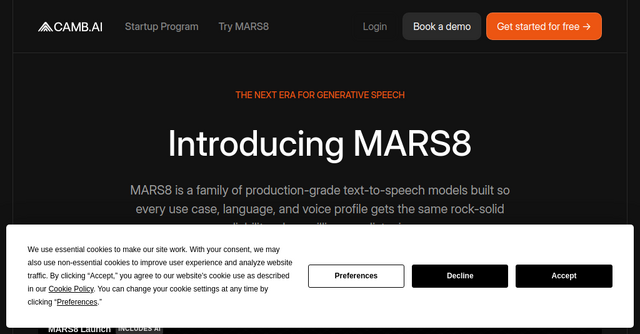
Beyond Demo-Ware: Why MARS8 is the TTS Engine Production Apps Have Been Waiting For
Most Text-to-Speech (TTS) tools today are built for the "demo" environment. They sound great when you’re clicking a button on a landing page, but they often crumble under the weight of real-world production. When you’re dealing with live broadcasts, massive scale, or high-stakes enterprise applications, a "good enough" voice model isn't just an inconvenience—it’s a liability.
If you’ve ever felt like your voice AI pipeline was held together by duct tape, or you’ve grown tired of the "API tax" that comes with proprietary cloud-locked services, you need to look at MARS8 Text to Speech AI Models.
MARS8 isn't trying to win an academic benchmark competition for the sake of a vanity metric. It was built for the environments where failure simply isn't an option: live sports, global news, and high-concurrency enterprise systems.
What Sets MARS8 Apart in the Voice AI Landscape?
The fundamental problem with many TTS tools in the Website and AI category is their lack of specialization. They try to be a "one-size-fits-all" solution, which inevitably leads to compromises. You either get high latency (which kills real-time agents) or low fidelity (which ruins the user experience for content dubbing).
MARS8 flips this script by offering a family of specialized models. Instead of forcing one model to do everything, they’ve engineered a suite of tools that cater to specific production constraints. This is the difference between a prototype and a product that scales to millions of listeners.
The MARS8 Model Family: Purpose-Built for Reality
When you integrate MARS8 Text to Speech AI Models into your stack, you aren't just picking a voice; you are selecting a model architecture optimized for your specific performance needs:
- MARS-Flash: This is your go-to for real-time conversational agents. By prioritizing the lowest Time to First Byte (TTFB), it ensures that your voice agents feel responsive and natural, rather than laggy and disjointed.
- MARS-Pro: Designed for high-fidelity tasks. If you are building tools for dubbing or audiobooks, this is where you get the balance of speed and emotional expressiveness that keeps listeners engaged.
- MARS-Instruct: This model offers director-level emotional control. It gives you the ability to fine-tune timing and style, making it ideal for film, TV, or creative workflows where the delivery is just as important as the words.
- MARS-Nano: For those working with hardware constraints, MARS-Nano brings production-grade quality to on-device and embedded systems. It’s perfect for automotive or edge deployments where you can't rely on a constant, high-speed cloud connection.
Why Indie Makers Should Care About "Production-Grade"
If you’re a solopreneur or building a SaaS, you know that "demo-ware" is the enemy of growth. When your product gains traction, your architecture undergoes a stress test.
Many developers start with a TTS API that works fine for a few users but becomes prohibitively expensive or unstable as you scale. MARS8 changes the game by being the first TTS model family that is natively available on every major cloud provider—GCP, AWS, and beyond. This is a massive win for indie developers who want to avoid the dreaded "API tax." By owning your infrastructure and deploying where it makes sense for your business, you retain control over your costs and your data.
Furthermore, with language support covering 99% of the world’s speaking population, you aren't limited to a single market. You can build your global media tool or voice agent knowing that the quality won't degrade just because you’ve switched languages.
Practical Scenarios for MARS8
How are people actually using this? The versatility of the MARS8 Text to Speech AI Models opens up several high-value use cases:
1. Real-Time Conversational AI
If you are building an AI customer support agent, latency is your biggest enemy. Using MARS-Flash allows you to deliver responses that feel instantaneous, reducing the "wait time" that often makes AI interactions feel robotic.
2. Global Content Localization
The media landscape is shifting. With MARS-Pro, you can automate the process of dubbing content for global audiences without sacrificing the nuance of the original performance. It’s a game-changer for creators who want to reach international markets without the overhead of manual voice acting.
3. Edge and Automotive Systems
With the rise of smart devices, there’s a growing need for high-quality voice interfaces that run locally. MARS-Nano allows you to deploy sophisticated speech synthesis directly on devices, ensuring privacy and reliability even in offline scenarios.
4. Creative Production
For filmmakers and editors, MARS-Instruct provides the granular control needed for professional-grade voiceovers. You can adjust emotional output and prosody to match the tone of a scene, moving your project from "generated voice" to "cinematic performance."
The Bottom Line: Stop Compromising
The AI space is crowded with tools that look impressive in a 30-second video but fail in a production environment. MARS8 is different because it was born in the trenches of live, high-stakes broadcasting. It’s built for the developer who is tired of choosing between speed, quality, and cost.
Whether you are building the next big conversational agent or a platform for global storytelling, you need a foundation that won't buckle under pressure.
Ready to move from demo-ware to production-ready?
Check out the full MARS8 Text to Speech AI Models documentation, run the benchmarks yourself, and see how these models perform against the current industry standards. Stop being trapped by limited APIs and start building something that can actually handle the scale of your ambitions.