Is Your AI SaaS Actually Profitable? Meet Grow or Die
Running an AI-powered product is a different beast than traditional SaaS. You aren’t just tracking churn and acquisition; you’re managing API usage, token costs, and the volatile nature of AI model expenses. If your dashboard shows a healthy stream of revenue but you’re still losing money every time a user prompts your chatbot, you have a visibility problem.
Most indie makers are forced to duct-tape their analytics together. You might have Google Analytics for traffic, Stripe for payments, and a separate spreadsheet to calculate how much you’re bleeding in OpenAI or Anthropic API costs. By the time you reconcile those numbers, the data is stale, and your decision-making is reactive instead of proactive.
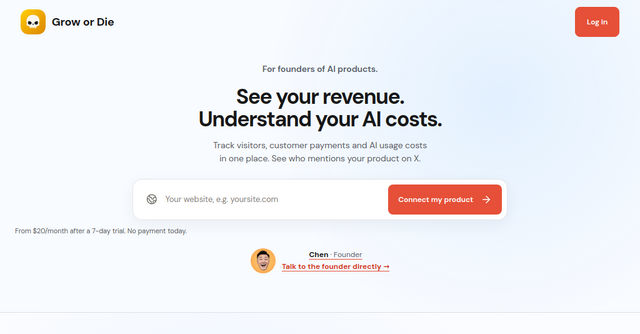
That is where Grow or Die comes in. It is a specialized analytics platform built specifically for AI product founders who are tired of guessing which features—and which customers—are actually moving the needle on profitability.
What is Grow or Die?
At its core, Grow or Die is a unified analytics dashboard designed to bridge the gap between acquisition and net profit. While most tools focus purely on vanity metrics like page views, this platform focuses on the "After AI Cost" reality.
It is categorized as a website analytics and business intelligence tool, but it functions more like a CFO for your indie project. By centralizing your search traffic data, customer payment activity, and AI consumption costs, it allows you to see the direct relationship between your marketing efforts and your bottom line.
Why AI Founders Need a Unified View
In the indie hacking community, we often hear that "revenue is vanity, profit is sanity." For AI products, this is even more critical. If you are paying $0.05 in API costs per generation but only charging your users based on a flat subscription, you could be losing money on your "power users."
Grow or Die solves this by showing you:
- Real-time Revenue vs. Cost: You get a clear view of your revenue minus AI costs. This is the "After AI Cost" metric that determines whether your business model is sustainable.
- Search and Traffic Attribution: Understand exactly where your visitors are coming from. By connecting your website, you can track which search terms and traffic sources lead to paying customers.
- Social Mentions: The platform tracks mentions of your product on X (formerly Twitter). In the indie space, social proof is everything, and knowing when and where you are being talked about helps you double down on the channels that drive growth.
Breaking Down the Key Features
1. The "After AI Cost" Calculation
This is the standout feature for the current generation of AI tools. By pulling in your payment data and your model usage costs, the platform calculates exactly what remains after those expenses. It accounts for taxes and refunds, giving you a transparent look at your actual margins. It removes the guesswork from pricing your AI tiers.
2. Full-Funnel Visibility
You’ll stop looking at search performance and revenue in silos. When you use this website analytics tool, you can see if your SEO strategy is actually attracting high-value users or just window shoppers who cost you money in API tokens without converting. It’s about understanding the journey from the first Google search to the final payment.
3. Social Monitoring
Indie products thrive on word-of-mouth. Grow or Die integrates social listening for X, allowing you to monitor who is mentioning your product. This is invaluable for community building and for identifying potential influencers or power users who could act as brand advocates.
Practical Use Cases for Solopreneurs
How does this look in practice? Let’s imagine a few scenarios:
Scenario A: Optimizing your pricing tiers You notice that 20% of your users are consuming 80% of your AI tokens. Through the dashboard, you realize these users are actually costing you more than they pay in subscription fees. With the clear financial data from Grow or Die, you can confidently adjust your pricing or implement usage caps to protect your margins.
Scenario B: Identifying high-intent traffic You’ve been writing blog posts for months but aren't sure if they convert. By syncing your website traffic data, you can see which specific search queries brought in users who went on to pay for a subscription. You can then stop writing content that doesn't convert and focus entirely on the topics that drive revenue.
Scenario C: Managing social growth A post about your tool goes viral on X. Instead of just seeing a spike in traffic, you can correlate that specific social mention with a jump in signups and payments. This helps you understand which types of social content actually lead to growth, rather than just "likes."
Pricing and Getting Started
One of the biggest hurdles for indie makers is the cost of tooling. You don’t want to pay hundreds of dollars a month for enterprise-level analytics when you’re still in the validation phase.
Grow or Die keeps it accessible for the indie community. The product follows a freemium model, with a paid offering starting at just $20/month. If you aren't sure if it’s the right fit for your stack, they offer a 7-day free trial with no payment required upfront. It’s a low-risk way to see if your current AI product is as profitable as you think it is.
Final Thoughts
If you are building an AI-powered product, you are playing a different game than a standard static SaaS. You have to account for the "hidden" costs of intelligence. By using a tool like Grow or Die to track your revenue and AI costs, you move from "guessing" to "knowing."
Stop relying on disconnected spreadsheets and start making decisions based on the metrics that actually keep your business alive. Whether you are a solo developer or part of a small team, having a centralized view of your traffic, payments, and AI expenses is the smartest move you can make for your long-term growth.
Ready to see your true profit margins? Check out Grow or Die today and start your 7-day trial to get a clearer picture of your AI business performance.