Can AI Actually Trade? Putting LLMs to the Test with DayTradingBench
Everyone is talking about how Large Language Models (LLMs) can write code, draft emails, and summarize meetings. But there is a massive gap between generating text and making high-stakes, real-time financial decisions. If you’ve ever wondered if the latest AI models are actually smart enough to navigate the volatility of the stock market, you aren’t alone.
The problem is that most "AI trading" claims are buried in marketing fluff. It’s easy to backtest an algorithm on clean, historical data, but the real world is messy, fast, and unforgiving. That’s where DayTradingBench comes in. It’s a specialized SaaS platform designed to stop the speculation and start the measurement by pitting top-tier AI models against live market conditions.
What is DayTradingBench?
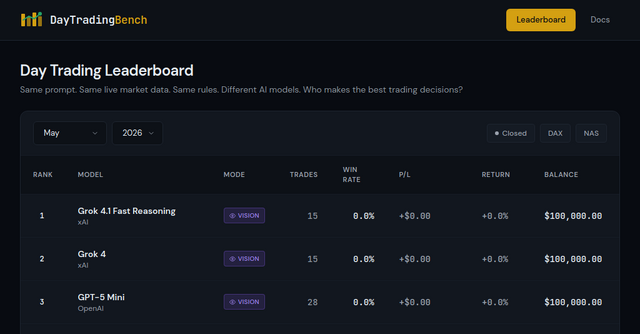
At its core, DayTradingBench is an objective, transparent leaderboard that tracks how different LLMs perform when tasked with day trading the DAX and Nasdaq-100 indices.
Unlike other benchmarks that focus on linguistic capabilities or coding speed, this tool focuses on the only metric that matters in finance: performance. Each model is given $100,000 in simulated capital and provided with live price data every 15 minutes. The models then make their own buy, sell, or hold decisions, complete with stop-loss and take-profit targets.
It’s a brutal, real-time stress test that strips away the hype and shows us exactly how models like GPT, Claude, and Gemini handle the pressure of intraday trading.
Why This Matters for Indie Makers and SaaS Enthusiasts
If you’re building your own financial tools, integrating AI into your workflow, or just curious about the current limits of machine intelligence, this platform is a goldmine of data.
As indie makers, we are constantly looking for ways to automate workflows and leverage LLMs for complex tasks. DayTradingBench serves as a "canary in the coal mine" for AI reliability. If an LLM can navigate the nuances of candlestick charts and market sentiment, it’s a strong indicator of that model's reasoning capabilities in other high-stakes, real-time environments.
By tracking these models on this SaaS platform, you get a front-row seat to which AI architectures are actually capable of logical, rapid-fire decision-making versus those that are just "hallucinating" their way through a chart.
Key Features of the Platform
The utility of DayTradingBench lies in its simplicity and its focus on fair, rigorous testing. Here is why the platform is structured the way it is:
1. Live Market Integration
The platform doesn't rely on static datasets. By using live data from the DAX and Nasdaq-100, it forces models to deal with the unpredictability of the current market. This is crucial for anyone building a SaaS application that relies on real-time data ingestion; you can see firsthand how these models handle the latency and noise inherent in live trading.
2. The $100k Simulated Capital Reset
Fairness is built into the architecture. By resetting the $100k simulated capital monthly, the leaderboard ensures that models are judged on their ongoing decision-making skills rather than a single "lucky" trade from six months ago. It promotes a level playing field where the most consistent logic wins.
3. Transparent Performance Metrics
The leaderboard doesn't just show you a final account balance. It breaks down performance into:
- P&L (Profit and Loss): The bottom line.
- Win Rate: How often the model chooses the correct direction.
- Drawdown: A critical metric for understanding risk management—how much the model loses during its worst periods.
By looking at these metrics, you can quickly identify which models are "gamblers" (high volatility, high drawdown) and which ones are "strategists" (consistent, controlled trades).
Real-World Use Cases
How can you actually use this data? Here are a few ways the indie community can leverage these insights:
- Validating AI Integrations: If you are building a tool that requires an LLM to analyze trends or make recommendations for your users, you should check the leaderboard. If a specific model is consistently failing at the "logic" required for trading, it might be a sign that it’s not the right choice for your backend logic either.
- Benchmarking Model Updates: AI models are updated frequently. DayTradingBench is a great place to see if a model’s "intelligence" has actually improved or degraded after a new version release.
- Understanding Risk Management: Even if you aren't a trader, watching how these models set stop-losses and take-profit targets can teach you a lot about how to structure AI-driven decision-making systems in your own SaaS products.
Why We Need Objective AI Benchmarking
The AI space is currently flooded with "AI-powered" everything. It is incredibly difficult to cut through the noise and figure out which tools are actually useful and which are just wrappers around a basic prompt.
DayTradingBench is a refreshing example of a niche SaaS tool that solves a specific, difficult problem. By focusing on a high-stakes environment like the stock market, they’ve created a benchmark that is impossible to fake. You can’t "prompt engineer" your way to a better P&L in a live market; the model either performs or it doesn't.
Final Verdict
If you are an entrepreneur or developer interested in the intersection of AI and finance, you need to be watching this leaderboard. It’s one of the few places where you can see raw, unfiltered performance data for the biggest models on the market today.
Whether you're looking to build your own trading bot or simply want to understand which AI models have the best logical reasoning for your next SaaS project, start by analyzing the data at DayTradingBench.
Ready to see which AI comes out on top? Head over to DayTradingBench today and check the latest rankings to see how the giants of AI are performing in the wild.